Find the Right Support for Your Child
If you have concerns about your child's emotional, behavioral, developmental, or mental health, taking the first step can feel overwhelming. You are not expected to navigate it alone. Learn about available supports and connect with services that meet your child's individual needs.
Understanding Maine Children's Behavioral Health Services and Programs
Learn about each service and program available for children and youth. Understanding what's available can help you make informed decisions about what may work best for your child and family.
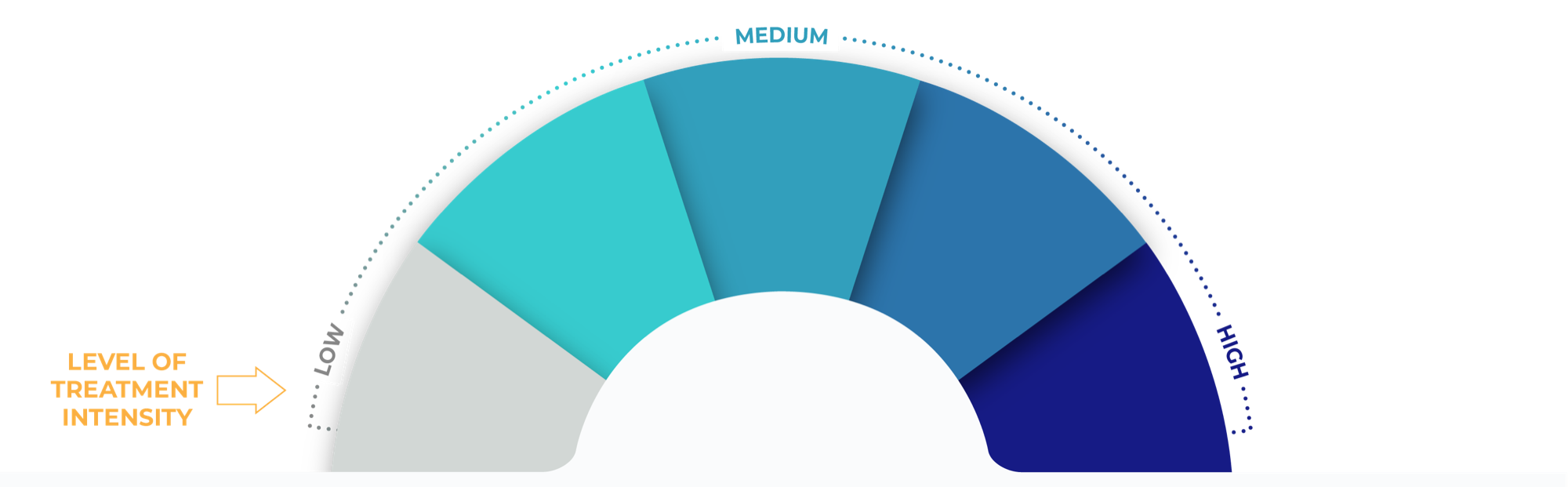
988, Crisis Stabilization Units, & Mobile Crisis Services span multiple levels across the continuum.
Get Connected
Maine CBHS understands that the right path to support will depend on the child and families' individual needs and circumstances. Working with your child's care coordinator from the start can help determine the most appropriate next steps.
Care Coordination helps families organize services, connect to supports, and keep communication clear among everyone helping the child.
A Care Coordinator can help you begin by:
- Discussing noticeable changes or differences in your child's behaviors, emotions, or daily functioning.
- Helping you Identify your child's strengths and challenges.
- Exploring available services and supports in Maine that meets your child's individual needs.
- Helping you better understand service eligibility requirements.
- Developing a plan tailored to your child and family's goals.
If you need help getting connected to a Care Coordinator, please contact our Lead Family Information Specialist.
Contact UsHelpful Resources
Health Coverage Assistance
Families of children who have private health care coverage or are not otherwise eligible for regular MaineCare coverage may still be eligible to receive assistance with health coverage related to behavioral health services.
MaineCare
MaineCare provides free or low-cost health insurance, other health benefits, and assistance to kids under age 21 who meet income guidelines or disability criteria.
Learn More about MaineCare (opens in new tab)Katie Beckett Option
Katie Beckett provides children under age 19, with serious health conditions who are over the income level for free MaineCare, may get MaineCare coverage through the Katie Beckett program. Children enrolled in the Katie Beckett program pay a low-cost premium for health coverage.
Learn More about the Katie Beckett Option (opens in new tab)The Single Assessment
For families of children with behavioral health disabilities who are at risk of out-of-home treatment, accessing the right services can be confusing. The Single Assessment is a new process designed to transform how children and families access medium- to high-intensity behavioral health services. The Single Assessment establishes medical necessity, level of care, and service eligibility for each child. Using one of the three age-appropriate, standardized tools, the assessment determines the level of service a child needs and identifies which services they are eligible to receive.
Beginning February 2026, the Single Assessment will function as the initial clinical authorization statewide for children seeking medium- to high-intensity services.
Standardized Tools:
- ECSII – Early Childhood Service Intensity Instrument. (Birth–5)
- CALOCUS-CASII – Child and Adolescent Level of Care-Service Intensity Utilization System. (6–17)
- LOCUS – Level of Care Utilization System. (18–21)
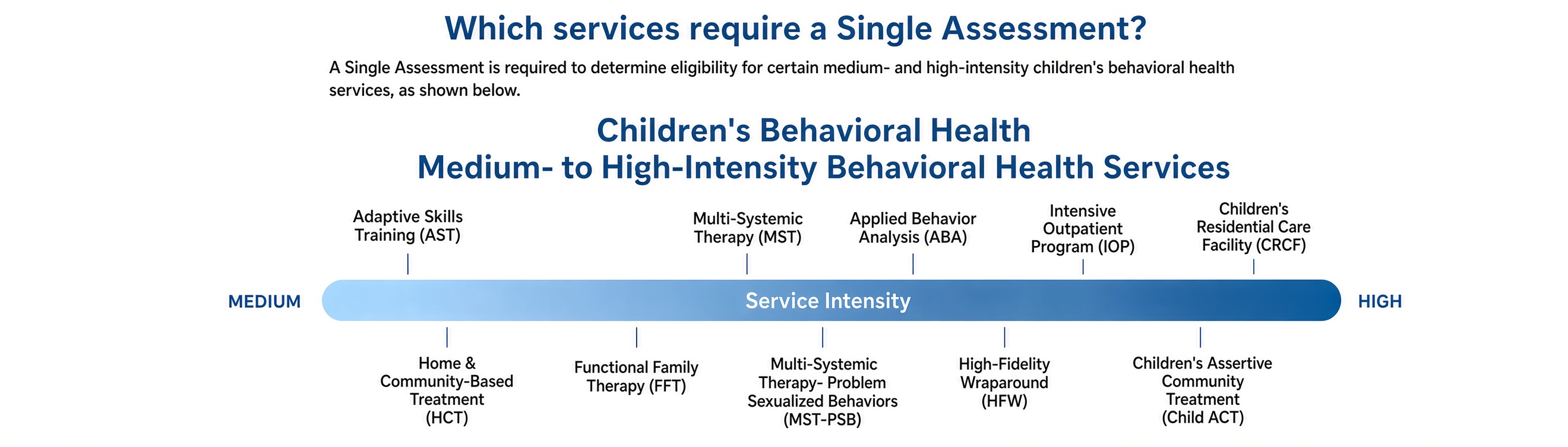
- AST
- HCT
- FFT
- MST
- MST-PSB
- ABA
- HFW
- IOP
- Child ACT
- CRCF
Access to a medium-to-high-intensity behavioral health service begins with a single assessment.
To get a Single Assessment:
Parents/Guardians
We recommend families begin by reaching out to their child's care coordinator or case manager. If your child does not have one, families can submit a Single Assessment Help Request Form (opens in new tab) and a member of the CBHS team will reach out within 3 business days to help.
Informational Resources for Families
Easy-to-use resources to guide families through the new single assessment process.
-
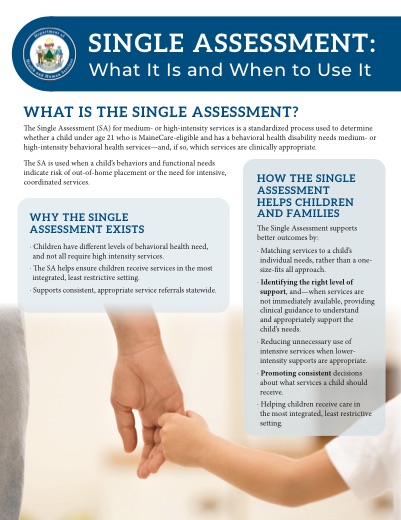
What is a Single Assessment?
- English version of What is a Single Assessment? (PDF, opens in new tab)
- Español version of What is a Single Assessment? (PDF, opens in new tab)
- Français version of What is a Single Assessment? (PDF, opens in new tab)
- العربية (coming soon)
- Português (Brasil) version of What is a Single Assessment? (PDF, opens in new tab)
- Soomaali (coming soon)
-
Single Assessment: Practical Guide for Families
- English version of Single Assessment: Practical Guide for Families (PDF, opens in new tab)
- Español (coming soon)
- Français (coming soon)
- العربية (coming soon)
- Português (Brasil) (coming soon)
- Soomaali (coming soon)
-
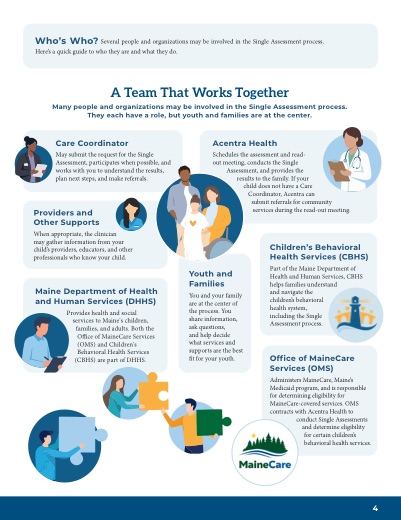
Who is Who?
- English version of Who is Who? (PDF, opens in new tab)
- Español (coming soon)
- Français (coming soon)
- العربية (coming soon)
- Português (Brasil) (coming soon)
- Soomaali (coming soon)
-
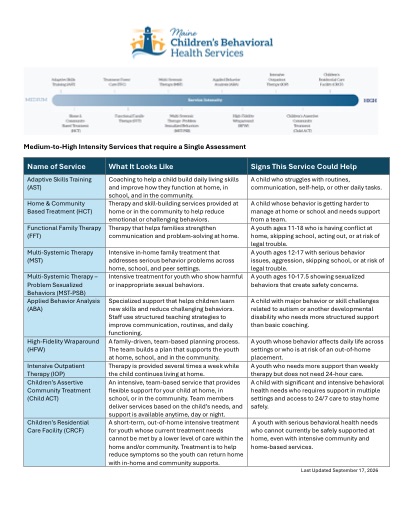
Services Requiring a Single Assessment
- English version of Services Requiring a Single Assessment (PDF, opens in new tab)
- Español (coming soon)
- Français (coming soon)
- العربية (coming soon)
- Português (Brasil) (coming soon)
- Soomaali (coming soon)
Informational Service Sheets
Select a service to view its information sheet.
Targeted Case Management (TCM) and Behavioral Health Home Support (BHH)
This service sheet is coming soon.
Crisis Services
This service sheet is coming soon.
Outpatient Mental Health Treatment
This service sheet is coming soon.
Medication Management
This service sheet is coming soon.
Rehabilitative and Community Support (RCS)
This service sheet is coming soon.
Specialized Rehabilitative and Community Support (Specialized RCS)
This service sheet is coming soon.
Home and Community Treatment Services (HCT)
This service sheet is coming soon.
Functional Family Therapy (FFT)
This service sheet is coming soon.
Multi-Systemic Therapy (MST)
This service sheet is coming soon.
Multi-Systemic Therapy – Problem Sexual Behavior (MST-PSB)
This service sheet is coming soon.
Adaptive Skills Training (AST)
This service sheet is coming soon.
Applied Behavior Analysis (ABA)
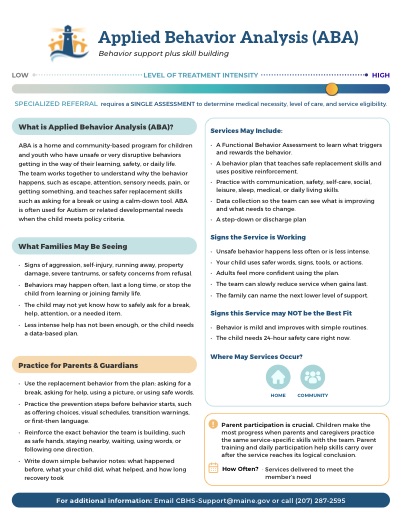
- English version of Applied Behavior Analysis (ABA) service sheet (PDF, opens in new tab)
- Español (coming soon)
- Français (coming soon)
- العربية (coming soon)
- Português (Brasil) (coming soon)
- Soomaali (coming soon)
High-Fidelity Wraparound (HFW)
This service sheet is coming soon.
Intensive Outpatient Program (IOP)
This service sheet is coming soon.
Children's Assertive Community Treatment (Child ACT)
This service sheet is coming soon.
Children's Residential Care Facility (CRCF)
This service sheet is coming soon.
Appeals
If you disagree with a Single Assessment result or recommended level of care, Guardians and youth may file an appeal through the DHHS fair hearing process.
Learn More about appeals (opens in new tab)Need Additional Support?
We get it. Sometimes it's easier to talk to someone directly. Whether you need help finding the right service, understanding your options, navigating available supports, or simply need guidance on where to start, we're here to help. Reach out to us using any of the contact methods on our Contact Us page.
Commonly Asked Questions
What if I'm not sure where to start?
If you're unsure what to do next, that's okay.
You can:
- Reach out to a provider for guidance
- Ask your child's doctor or school for support
- Connect with a care coordinator who can help you navigate options
You don't need to have all the answers before reaching out.
Contact UsI'm concerned about my child's behaviors, what do I do?
If you're concerned about your child's behaviors, it's important to get appropriate care. You can:
- Talk to your child's doctor, school nurse, or another healthcare provider to seek further information about the behaviors and symptoms that worry you.
- Ask your child's primary care physician if your child needs further evaluation by a specialist with experience in child behavioral problems.
- Ask if your child's specialist is experienced in treating the problems you are observing.
- Talk to your medical provider about any medication and treatment plans.
What are some recognizable signs that my child may need additional support?
Every child is different, but if you start to notice your child experiencing any of the following, it may be time to seek support.
- Significant changes in mood or behavior
- Increased anxiety, sadness, or irritability
- Difficulty at school or with peers
- Changes in sleep, appetite, or daily routines
- Frequent emotional outbursts
- Withdrawal from activities they previously enjoyed
- Ongoing challenges that affect daily life at home, school, or in the community.
I'm starting to see changes in my child's behavior, emotions, relationships, school performance, or daily functioning. What's going on?
These noticeable changes could be signs that your child is struggling and additional support may be helpful. Reach out to a trusted individual to start a conversation.
Who can I talk to if I have concerns about my child's emotional, behavioral, or mental health?
Begin by talking with a trusted individual involved in your child and family team such as:
- Your child
- Family members or caregivers
- Teachers or school staff
- Medical providers
- Behavioral health providers
- Your child's care coordinator or case manager
- Family support groups
Where can I find tips and helpful resources for starting the conversation?
Here are some helpful resources and tips:
- Starting the Conversation: SAMHSA Families Conversation Guide (opens in new tab)
- Helping a Loved One: SAMHSA Family Support Guide (opens in new tab)
- How to Talk to Parents and Caregivers of Children about Mental Health: SAMHSA (opens in new tab)
What programs and services are offered in Maine?
A range of home- and community-based behavioral health services are available to meet the unique needs of each child and family.
View Programs & ServicesAre there recognizable signs that a medium-to-high intensity behavioral health service could help my child?
If you think a medium-to-high intensity behavioral health service could help your child, you can review the Children's Behavioral Health Services Summary sheet for Medium-to-high intensity services that require a Single Assessment (opens in new tab) to learn the signs that this service could help.
If you see any of these signs in your child, getting a Single Assessment for your child will be the appropriate next step.
What if my child is in a crisis?
If your child is experiencing a behavioral health crisis, support is available right away. Call or text 988, or visit the 988 Suicide & Crisis Lifeline (opens in new tab). Support is available 24 hours a day, 7 days a week.
What is the Single Assessment?
The Single Assessment is for MaineCare members under age 21 who may need medium- or high-intensity behavioral health services. It looks at the child's strengths, needs, behaviors, functioning, and goals to determine the level of care that will best meet their needs.
Learn more about the Single AssessmentWho is eligible for Services and Support?
Eligibility for services varies depending on the specific program or service being accessed. While some services have broad eligibility criteria, others may have additional requirements related to age, diagnosis, level of need, insurance coverage, or other factors.
See the list of Programs & Services above to learn more about each service and its specific eligibility requirements.
Does MaineCare or private insurance cover these services?
Many behavioral health services for children and youth are covered through MaineCare. Families of children who have private health care coverage or are not otherwise eligible for regular MaineCare coverage may still be eligible to receive assistance with health coverage related to behavioral health services.
Click here to learn more about health coverage options for children (opens in new tab)How do I contact CBHS?
We get it. Sometimes it's easier to talk to someone directly. Whether you need help finding the right service, understanding your options, navigating available supports, or simply need guidance on where to start, we're here to help. Reach out to us using any of the contact methods on our Contact Us page.
If a child or youth in Maine is experiencing a behavioral health crisis, call or text 988.